
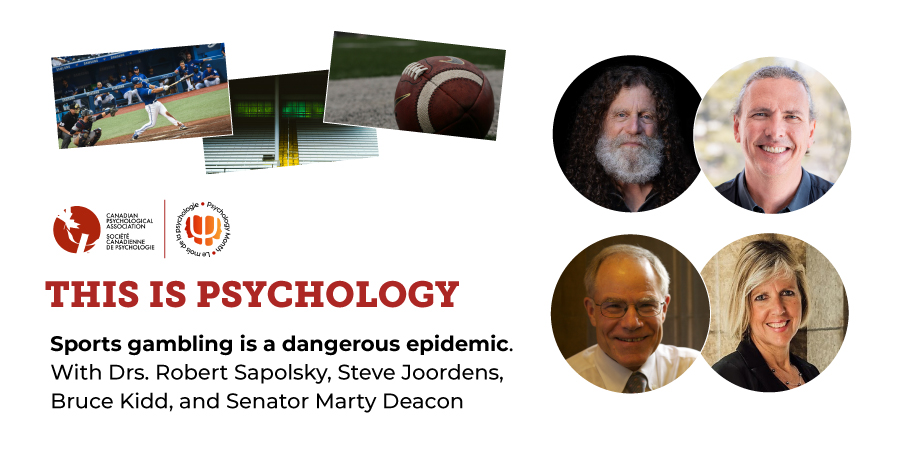
Canada legalized single-event sports betting in 2021. In the three years that followed, gambling on sporting events in the country rose tenfold. Today, one in five people who bet on sports do so every single day. Our young people are particularly vulnerable, and have been specifically affected by gambling addictions. Bruce Kidd and Steve Joordens are looking to ban advertising for sports gambling in Canada. Senator Marty Deacon has introduced bills to this effect. And Stanford psychologist Dr. Robert Sapolsky explains just what makes sports gambling so dangerous. All four joined us for this Psychology Month look at the dangers of sports gambling and the possible solutions to the problem.
In the early 60s, Bruce Kidd was preparing to represent Canada at the Olympics. He had just received the Lou Marsh award as Canada’s top athlete, and he was speaking at an event and being critical of the way gambling had infiltrated the sports world. At the head table of that event was Paul Hornung, the then-superstar halfback and kicker of the Green Bay Packers. Bruce remembers,
“[Hornung] passed along a note saying he’d like to meet me in the parking lot after the banquet, that being the traditional invitation to a fight, and I made a quick exit out the other way.”
Two weeks later, Hornung was suspended indefinitely by the NFL for gambling. He and Lions superstar Alex Karras had been betting on NFL games and “associating with undesirable persons” (gamblers). Both players were forthright and contrite, and the NFL felt comfortable allowing them back into the league the following year. Despite betting on NFL games, they were both elected to the Pro Football Hall of Fame in Canton.
Back then, gamblers were “undesirable persons”. They were the shady characters we imagine being played in a movie by Edward G. Robinson. To place a bet, you had to know where to find the illegal bookmaker, sneak in and out of their establishment, leave behind your money, and take your ticket to watch the game in a few days. It was a process. It also gave you time to anticipate your possible win when the Baltimore Colts covered the spread against the St. Louis Cardinals.
Today, things are much different. Handheld devices make it possible to bet not only up to kickoff, but on the distance of the return, whether the next play will be a running play, how many yards the backup tight end will have by the end of the first quarter. As that first quarter ends, you have TV commentators deviating from analysis of the play to analysis of the betting lines. They make suggestions for bets you might want to place before halftime. By the time the game is over, you might have placed eleven bets. You’re unlikely to have won all eleven.
The passion Dr. Bruce Kidd brought to the argument against sports gambling back in the 60s has not abated. Today, as a professor emeritus in Sport & Public Policy and a university Ombudsperson at the University of Toronto, he is doing everything he can to combat the dangers posed by the modern gambling landscape. He has created the website Ban Ads for Gambling to inform and energize the public to fight against the way sports gambling is marketed, in particular to teenagers.
Dr. Robert Sapolsky is a professor of biology, neurology, and neurosurgery at Stanford University. He agrees with Bruce that children are particularly vulnerable to gambling ads and apps.
“Children are absolutely more susceptible to this. We’ve got this very fancy part of the brain called the frontal cortex. It’s the most recently-evolved part of the human brain. We have more of it, and in a more complex way, than any other species. And what it does is things like self-regulation, impulse control, long-term planning, and executive function. The job of the frontal cortex is to calm the more emotive parts of your brain, like the dopamine system, or the parts having to do with aggression or sexual arousal. It tells those other brain areas ‘I wouldn’t do that if I were you. Trust me, I know it seems like a good idea right now, but don’t do it’.
The frontal cortex is the thing that keeps you from doing hideously impulsive things that seem like a good idea at the time, but that you will regret for the rest of your life. So why isn’t the frontal cortex keeping young people from making rash decisions? It’s because the frontal cortex is the last thing to develop. Most of your brain is fully developed around the time you’re getting toilet trained or learning how to walk up and down a flight of stairs. But the frontal cortex isn’t fully online until you’re about a quarter of a century old.
By contrast, the dopamine system is pretty much up-to-speed around the time you’re reaching puberty. This means a dopaminergic engine of disordered and distortive anticipation is there in you, while your frontal cortex is firing on only one cylinder. It can’t regulate it. It’s why adolescents behave in adolescent ways – impulsiveness, sensation-seeking, novelty-seeking, being slow to habituate to negative feedback, that’s what adolescence is about, and it’s mostly because your frontal cortex is still sort of percolating.”
It’s during that time of adolescence when young people, boys in particular, start paying more attention to both sports and their phones. When they watch a hockey game and between periods they see the play-by-play announcer and colour commentator debating what player will score the next goal, adolescents don’t have the same mechanism the rest of us do to slow down the impulse to place a bet based on the seemingly expert advice being dished out by the sportscaster.
Dr. Steve Joordens is a professor of psychology at the University of Toronto. He saw his old friend (and former boss) Bruce on TV, speaking as the Chair of the Campaign to Ban Ads for Gambling, and jumped on board immediately. For Steve, the most insidious thing about ads that encourage sports gambling is not just that they target young people, but that they use psychology to do so. The marketers, the app designers, and the promoters of gambling are all well-versed in methods of persuasion that are derived from psychological principles. Steve wrote an article about it, ‘Sports Gambling and the Weaponization of Psychology’, where he said,
“Society needs to restrict the marketing of sports gambling as soon as possible. It reflects a weaponization of psychology that is designed to create addictions. This is not hyperbole. A headline for The Hill reads ‘Sports betting has risen tenfold in three years. Addiction experts fear the next opioid crisis.’ A Harris Poll from November 2022 reported that 71% of those who bet on sports did so at least once a week with 20% betting once per day! The website suicide.ca has an entire page dedicated to helping those with gambling addictions.
Sports gambling is so dangerous because of the psychological power of random rewards. When players gamble, they lose more often than they win, However, the random nature of wins means they never know when that next win is coming. They start chasing that next win. At the neuroscientific level, the hormone dopamine is released when one is chasing a desired outcome and this release feels good, literally the thrill of the chase. Each loss can make the player feel one step closer to that next win, which always feels like it’s just around the corner. This makes the player ‘resistant to extinction’. Once they start, they don’t want to stop, especially after a string of losses.”
Dr. Sapolsky describes the mechanism by which dopamine encourages certain behaviours. Dopamine is the neurotransmitter that regulates pleasure, and many of us are familiar with dopamine experiments done with animals like rats or monkeys. For example – a light goes on, which is the signal to press a lever, and that pressing of the lever distributes a treat of some kind. But the dopamine isn’t released when the treat is revealed, or when it is consumed. And it isn’t triggered when the lever is pressed. Instead, the dopamine rush felt by a rat or a monkey or indeed a human being happens when the light comes on. It’s the anticipation of the reward, not the reward itself, that activates our pleasure centres. He explains further.
“Dopamine goes up when the signal comes on. You see the light and you think ‘oh, this is going to be great – I press the lever ten times and I get my reward. I have control, I have agency!’ The dopamine is triggered by the anticipation, not by the reward itself. And if you block the dopamine release, you don’t get the lever-pressing. Because it’s not just about the anticipation, it’s about the motivation you must have to do the work needed to get that reward.
For those familiar with our U.S. Constitution, it’s not the ‘pursuit of happiness’, it’s the happiness you derive from the pursuit, and the motivation you derive from the pursuit. We’re a totally bizarre species in that a monkey can learn to lever-press, raise dopamine with the anticipation, and get a reward thirty seconds later. While we’re the species that can get a signal, and do the required work, and wait for a reward years from now. To get a good job because you studied hard in school, or to leave the planet better for your grandkids, to get a reward after you’re dead! We can sustain that anticipatory dopamine and work really really hard for rewards that are way off in the future.
Where this applies to gambling is if we take the scenario of doing the work and getting the reward, and we shift things a little. This was the work of a guy named Wolfram Schultz at Cambridge, who’s the pioneer in this field. We shift things so you get the signal, you do the work, and you get the reward – only 50% of the time. So what happens to the amount of dopamine you get when the signal comes on? Is it a little bit smaller than when there’s a 100% chance of a reward? No! What you see is that dopamine goes even higher, and 50% drives the system even more. You’ve now introduced a new word into the experiment – ‘maybe’. And ‘maybe’ fuels the system like you wouldn’t believe.”
50% is, in fact, the magic number here. At 40%, the dopamine is not as strong, because the person knows that they are more likely than not to be disappointed. At 60%, the same thing happens because the person knows they are more likely to get a reward than not. 50% creates the greatest uncertainty, and therefore the greatest dopamine rush. This is a psychological principle that has been central to casinos around the world. Blackjack players win about 49% of the time. Craps, 49.5%. Roulette, 48.6%. Not only do the almost-even odds enhance the anticipation of the players, this setup keeps them at the table playing longer and spending more money.
Gambling scandals are nothing new to sports. Boxing has been dealing with accusations of match-fixing since the beginning. There have been scandals in sumo wrestling, badminton, darts, and e-sports. But in North America, the biggest gambling scandals that stick in the public consciousness have been around baseball. The National League was established in 1876 to provide an alternative to the wildly corrupt match-fixing culture that permeated the sport at the time. Eight members of the 1919 White Sox conspired to throw the World Series at the behest of gamblers. Pete Rose was famously banned for life in 1989 because he bet on his own games. In the early 80s, Major League Baseball threatened two of the sport’s biggest icons, Willie Mays and Mickey Mantle, with permanent bans because they were working as greeters at a casino. Baseball spent more than a century fighting to preserve the public perception of integrity in the game, and any association with gambling undermined that credibility.
Then, in 2018, the U.S. Supreme Court declared a federal ban on sports gambling to be unconstitutional, and the floodgates opened overnight. Gambling could now expand outside Nevada, where it had been confined to Las Vegas for decades. Sports books, apps, and website sprang up almost immediately, and the money began pouring in. By 2021, the Canadian government had followed suit, legalizing single-game betting in our country.
It’s hard, one imagines, to say “no” to money. Especially when that money comes in really, really easily. Every major North American sports league has hopped into bed with gamblers with both feet. Even baseball, which for so long had fought to keep even the appearance of impropriety at bay, caved to the allure of the easy dollars. Why try to track down and make deals with sponsors and advertisers when gambling apps just deliver a dump truck full of money to you? It requires little effort to say ‘yes’, and your sport is now suddenly more lucrative than ever.
The sports leagues are raking in easy money. Athletes are raking in easy money. Connor McDavid and Wayne Gretzky are teaming up for Bet MGM ads. The Manning brothers are shilling for Caesar’s Sportsbook. Charles Barkley is endorsing FanDuel, LeBron James is endorsing DraftKings, and even college athletes like gymnast Livvy Dunne are appearing in ads for Fanatics Sportsbook.
It takes a huge amount of money to pay all the celebrity endorsers, to run ads from beginning to the end of every game, and to sponsor every halftime show, every intermission, and every pre- and post-game show we sports fans consume. That money comes from people. People who are gambling on sports, who are getting in over their heads, and who are increasingly seeing gambling as a normal, obvious part of the sports-watching experience.
Is it possible to put this cat back in the bag, to convince sports leagues swimming in easy money to go back to their now-antiquated business models? In just a few short years, the intertwining of professional sports and legalized gambling has made such a task gargantuan. Steve and Bruce think the place to start is with the advertising, and they are doing everything they can to stem the tide. Steve has hosted webinars, written op-eds and essays, and in 2025 he appeared before the Senate of Canada on behalf of the CPA. In his testimony, he said,
“Allowing any form of marketing of gambling runs completely against our members’ attempts to prevent and address mental health issues. It pushes all Canadians to consider betting, with an especially strong impact on our children and our marginalized communities. There is no need to market gambling. Would-be gamblers can easily find legal gambling on their phone apps, apps which can be policed. The Canadian government must not allow companies to push our population into addiction and, with all due respect, I ask all of you to help us help Canadians. As a country we can do better. We should and must ban the marketing of gambling.”
The Honorable Senator Marty Deacon was one of those who were receptive to Steve’s call to action. She says she doesn’t (yet) regret her vote in 2021 to legalize single-sport betting, but acknowledges that more care should have been taken at that time in regard to the advertising component of legalized gambling.
“Without the regulation of gambling, it was all happening in an underground, unregulated way, and taking in billions and billions of dollars. I don’t regret voting for the bill – yet – but the part that probably wasn’t given enough time and consideration was the media piece, the advertising piece. When the bill became law in the summer of 2021, a door opened quickly and strongly to advertise, and that was out of control. Part of our inundation of advertising is due to the way it was set up. Private sector companies were allowed to operate and compete against one another, which drove up the amount of advertising.”
Senator Deacon has recently introduced a bill to limit the advertising of sports gambling. What the bill says is that ads for gambling would be prohibited during the airing of the game itself. From puck drop to final whistle, from opening pitch to final out, there would be no gambling ads encouraging us to bet our money. (In fact, she is re-introducing this bill, which has moved through the Senate and the House before but has been stalled by elections and new governments. When a federal election chooses a new government – even if the incumbent party is victorious – all bills that have not yet become law die. They must then be re-introduced and go through the same procedure all over again.)
“I’m passionate about sport, and safe sport for all. What was amazing to me was the impact this was having globally on certain populations. For older people, just an annoyance with constant ads on the TV and pop-ups on their phones. But a combination of electronic communication, the pandemic, and traditional media, has left young people really exposed. And the ones who seem to be most impacted by addictive behaviour are younger males, around 14-34. All populations are vulnerable, but that’s a significant one.”
In just the past two years, the number of gambling scandals affecting the sports world in North America has skyrocketed. College sports have had to deal with a litany of incidents where players and coaches are found to be gambling. The NFL has suspended more than a dozen players and team employees. Golf, tennis, UFC, the NBA, and the NHL have all had issues of their own. And in baseball, the scandals are piling up in a major way. Shohei Ohtani’s translator stole more than $16 million to fund a gambling habit. Other players have received lifetime bans and even umpires have been disciplined for gambling. It’s a sport that lends itself remarkably well to today’s gambling landscape. When you can bet on the first pitch to the second batter in the fifth inning being high and outside, then what seems like a meaningless one-off play in the game can be an alluring prospect for that pitcher.
When the lines that hitherto defined the integrity of a sport become blurred, it sends incredibly mixed messages to the players involved in that sport. Players who, in many cases, are young enough that they do not yet have fully developed frontal cortexes either. You can give an interview on the DraftKings pregame show, you can accept a boatload of cash to endorse FanDuel, but you’d better not actually gamble! THAT’s unethical!
When the lines get blurred for athletes, they must also get really blurry for fans. Where once you might have rooted for the Ottawa RedBlacks on TV 18 times per year, and maybe attended a couple of games, now that doesn’t feel like being a committed fan. If you’re truly committed to the RedBlacks, you’ll bet on them to win, to cover the spread, and for Adarius Pickett to break up two passes in the third quarter. It’s just what people who watch sports do, isn’t it? Dr. Sapolsky says the ability to make these in-game decisions is particularly difficult to manage, because it doesn’t give the frontal cortex time to catch up.
“When you’re sitting in your Vegas hotel room late at night and thinking ‘oh my god, there goes half the kids’ college money’, it gives you some time to think about it, and some time for the frontal cortex to get things under control. By contrast, when it’s a fast decision, it is hopeless that the frontal cortex is going to get there in time. It’s the impulsiveness of violence, or the impulsiveness of pressing a button on your phone.
When I was a kid in New York City, they legalized what they called ‘off-track betting’, where you no longer had to go to the racetrack itself to place a bet. They had these nice shiny locations with friendly high school kids behind the counter taking your money, and it was all straightforward. And best of all, the money the state was getting from off-track betting was being spent on education. Great news right, it’s being used for something beneficial! What gets lost in that is that the money you are taking from people who are gambling away their savings is disproportionately from poor people. It’s redistributing the wealth in the worst possible directions. Here in the United States, a lot of that is because people without money are psychologically manipulated into thinking ‘I’m actually a rich person who just hasn’t gotten rich yet’.”
A gambling addiction is a little bit different than other addictions, in that the effects of it can be much more devastating. Once a person realizes they need help for a dependence on cocaine, or alcohol, they can take the steps they need to get better. Although it can be very difficult, with the support of family and friends they can turn things around and recover. With gambling, the same is true – but even after recovery there is something hanging over their head. An enormous and often life-altering amount of debt. It’s no wonder that suicide prevention websites have sections dedicated entirely to gambling.
So what can we do? Most people – including many mental health professionals – think that an outright ban on gambling is a non-starter at this point, and that even attempts to ban advertising for it will face stiff opposition. The proposed solutions nibble around the edges, and could make a difference, but they are unlikely to do anything major to stem the tide. Steve has a few suggestions, including adding a feature to gambling apps where every time you log in you get to see a running count of how much money you have won or lost. It might make us pause for a moment when we open our app and see that we’ve lost $12,000 in nine months. That pause might give our frontal cortex enough time, and enough data, to make us reconsider going back in to place another bet and lose more money. He also makes a point about the way we advertise (or don’t) other products.
“We have legal THC in Canada, you can go buy cannabis anywhere you want, but it is not advertised. Remember the Steppenwolf song The Pusher from the 60s? It makes the distinction between someone who goes out and finds a dealer, versus someone who isn’t looking but the dealer finds them and pushes their product. A ban on advertising for THC says ‘it’s a free country, you can do what you want to do, but there’s a reason to worry here so we’re not going to encourage this behaviour’.”
Dr. Sapolsky says that while the intention makes sense, an outright ban on gambling itself could end up backfiring, particularly among young people.
“I can see [making it illegal to gamble] backfiring, with the allure of the illicit. I’m not sure it would work on young people, because the ban could make them feel like teenage desperados, you know. Cigarette companies have figured this out, introducing vapes in bright colours and with exotic flavours. It combines the appeal of the illicit with the attention-grabbing novelty of the product, and even though vapes aren’t advertised, the industry is incredibly lucrative and really skilled at taking money from teenagers.”
Senator Deacon says we’re going to get there one step at a time.
“To move this through the Senate and the House, based on what we’ve learned with alcohol and tobacco, I felt that a full ban [on advertising] would have really slowed down the intent of the legislation. My bill is a moderate way to get the ball rolling, and the House can take over the bill and do a full ban if that’s what they like. Some of the things we could be looking at are ‘ten before and ten after the whistle’ (so no ads during the game itself). Denmark is doing this, and gambling companies there can advertise only between 1 am or 5 am. Also, anyone doing the advertising, or appearing in the ads, must be over 25 and can’t be an athlete.”
She also says that while letters and emails to MPs do work, emails and letters to senators do as well. For people who care about this issue and are passionate about it, contacting your elected officials, and unelected officials, goes a long way and could move legislation along to the point of a full ban.
“Now the bill is sitting in the House, and it has been presented there. We want families, organizations, and Canadians to reach out to their MPs. Bruce’s Ban Ads For Gambling group is very effective in doing this, and it makes more of an impact coming from him and from Steve than it does coming from me.”
Bruce, and Steve, and their colleagues from all over are going to continue this work as long as they can. As Dr. Sapolsky said, we human beings are unique in that we can put in the work today for a reward that may not come for a long time. To join the campaign, visit Bruce’s website and click ‘get involved’ for a form to send a letter to your MP. Be vocal about your opposition to sports gambling ads. And if you’re on one of those apps, take a moment to look back over your results and take stock. Maybe determine whether it’s a good idea to continue placing those bets. Your frontal cortex will thank you.