





Spotlight
Psynopsis Vol.48, Issue 2.5 Special Convention Issue now available online
Psynopsis Volume 48, Issue 2.5 Montréal Convention Special Edition is now available.
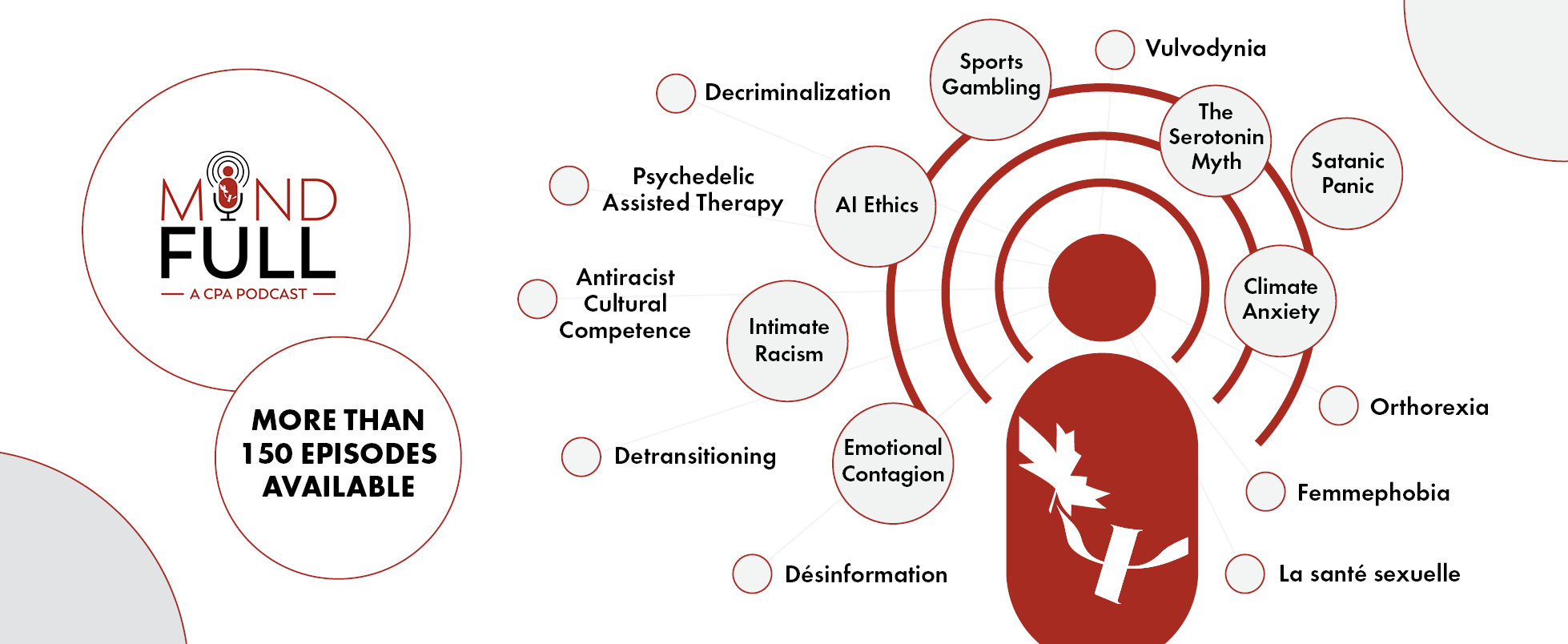
Mind Full, a CPA Podcast: Cancel Culture with Dr. Anne Wilson
- Cancel culture has been around for centuries, maybe for as long as human beings have been around. Today, though, it’s a lot more visible. It also (appears to be) a lot more pervasive than it ever has been before. Dr. Anne Wilson joins Eric to discuss this phenomenon, as well as the myriad of other ways in which our cultural divides get exacerbated.
New “Psychology Works” Fact Sheet
Psynopsis Vol.48, Issue 2 now available online
Psynopsis Volume 48, Issue 2 on Behavioural Addictions is now available.
New “Psychology Works” Fact Sheet
CPA Releases Roadmap to Increase Psychologists in Health Services (May 2026)
As Canadians continue to struggle with high rates of mental illness and shortages of specialists such as psychologists, the CPA released a report Increasing Access, Reducing Costs and Improving Outcomes: maximizing psychologists’ contributions to Canada’s publicly funded health care systems. The report outlines five key strategies to help close critical gaps in access and ensure that those in need receive timely, cost-effective, evidence-based psychological care. See our news release, executive summary and the full report.
Policy Statement: Artificial Intelligence In Psychology
The CPA’s Board of Directors has approved a new policy statement on AI in psychology. For more information: https://cpa.ca/aboutcpa/policystatements/#AI
CPA Opposes Changes to Interim Federal Health Program (April 2026)
In a letter to the Hon. Lena Diab, Minister of Immigration, Refugees and Citizenship of Canada (IRCC), the CPA voiced their concern about the IRCC’s plan to introduce a copayment model for services provided under the Interim Federal Health Program (IFHP). The IFHP provides health services (including psychological services) to refugees and asylum-seekers in Canada, and the CPA argued that the introduction of a copayment model would equate to denying services to this vulnerable population. You can read the letter here.
2026 CPA Student Research Grant Winners Announced
The CPA is pleased to announce the winners of the 2026 CPA Student Research Grants. These grants recognize exceptional student research in all areas of psychology. This year, grants were provided by the CPA, jointly by the CPA and CSBBCS, and by BMS Canada.
Congratulations to all!
CPA Report Reviews the Number of Psychologists in Canada (December 2025)
Given the growing importance placed on access to mental health care services and the role of psychology, the CPA has released a report that reviews the publicly available data collected by the Canadian Institute for Health Information from 2017 to 2023 on the number of psychologists in Canada. Moving forward, the policy primer identifies two related next steps that need to be considered.
New Booklets Released – Phonological Awareness Activities for the Kindergarten-Age Child
The CPA is pleased to announce the release of two research-based booklets designed to help kindergarten children with phonological awareness.
These booklets were created in response to recent endorsements of kindergarten reading programs that emphasize the phonics approach over the whole-language approach. The first booklet, titled, Promoting Reading Success: A Teacher’s Guide to Phonological Awareness Activities for the Kindergarten Child, is intended for use by teachers and can be purchased on the Publications page of the CPA website. The booklet is available in both English and French. To learn more about this booklet, you can read the Preface here. The second booklet, titled, Promoting Reading Readiness: A Parent/Caregiver’s Guide to Phonological Awareness Activities for the Kindergarten-Age Child, is intended for use by parents and caregivers, and can be downloaded for free by clicking here – you also can find the link to this booklet on the Publications page of the CPA website.
If you know of any teachers, parents, or caregivers who may benefit from these booklets, please share this information with them.
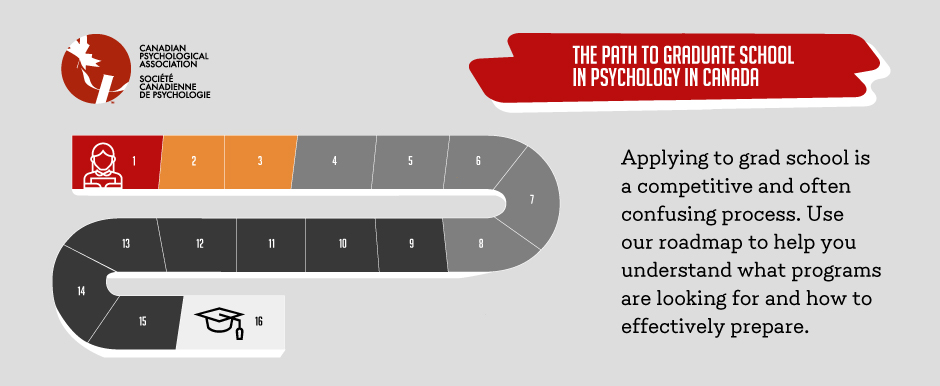
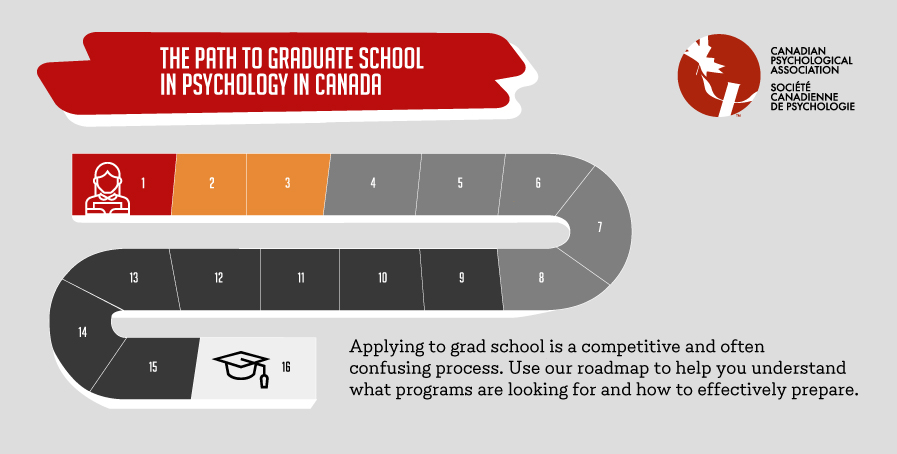
The Path to Graduate School In Psychology In Canada
Applying to grad school is a competitive and often confusing process. Use our roadmap to help you understand what programs are looking for and how to effectively prepare.
CPAP Group Benefits Survey
The Council of Professional Associations of Psychology (CPAP), in collaboration with the Canadian Psychological Association (CPA), is seeking input on a potential group benefits plan for psychologists.
We ask that you please complete the brief survey below which asks whether you’re interested in a group benefits plan and if so, the coverage and features you would like offered/implemented.
English – https://web2.cpa.ca/membersurveys/index.php/415456?lang=en
French – https://web2.cpa.ca/membersurveys/index.php/415456?lang=fr
Thank you for taking the time to complete this survey.
The CPA’s Scientific Affairs Committee is Seeking New Members!
The Canadian Psychological Association’s Scientific Affairs Committee (SAC) is currently recruiting new members. The SAC’s primary aim is to advance psychological science by working on matters of importance to the psychological research community, CPA members and affiliates, and groups of researchers. It is also responsible for the policies and practices of the CPA’s journals and other publications.
Yearly activities of SAC members include reviewing student research grant applications, providing input on CPA journal matters (e.g., publishing agreements, open-access wording, publishing standards), and reviewing special issue proposals for the journals. Additional activities will come up throughout the term. For more information on the SAC, or to read the SAC Terms of Reference, click here.
If you are interested in joining the important work of the SAC, please send a letter of intent and updated CV to Dr. Lauren Thompson, CPA’s Science Director at science@cpa.ca. In your letter of intent, please specify whether your research falls primarily within the mandate of SSHRC, NSERC, or CIHR.
CPA’s 2025-2030 Strategic Plan
It is with great pleasure that the CPA’s Board of Directors releases the CPA’s 2025-2030 Strategic Plan.
The CPA’s Board wishes to thank all members, affiliates, and associates who took the time, whether as individuals or as part of a collective, to provide input as part of our open consultation and call for feedback. With the new Strategic Plan, we have refreshed the CPA’s Vision, Mission, and Strategic Priorities. More…
 Cancel culture has been around for centuries, maybe for as long as human beings have been around. Today, though, it’s a lot more visible. It also (appears to be) a lot more pervasive than it ever has been before. Dr. Anne Wilson joins Eric to discuss this phenomenon, as well as the myriad of other ways in which our cultural divides get exacerbated.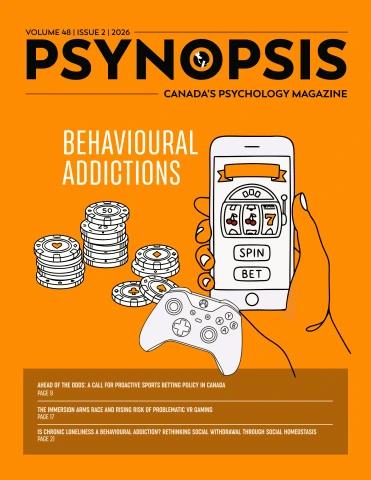
Featured Activities and Products
-

COVID-19 Public Resources & Member Messages
Read more -
CPA Career Hub
Read more -
Recruit Research Participants Portal (R2P2)
Read more -
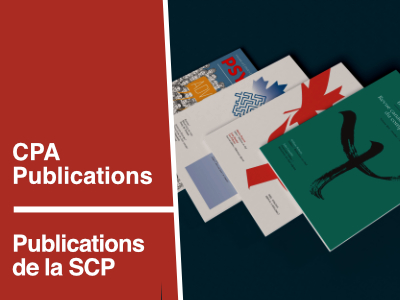
CPA Publications
Read more -
Advertising with the CPA
Read more -
Career Advertising
Read more -
Continuing Professional Development Online Courses
Read more -
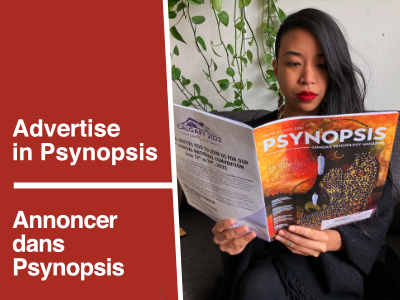
Advertise in Psynopsis
Read more -
Professional Liability Insurance
Read more



The Canadian Psychological Association (CPA) respectfully acknowledges that its Head Office and staff are located on the traditional unceded territory of the Algonquin Anishnabeg Peoples. The CPA is committed to being an association that is accountable to Indigenous peoples through our response to the Truth and Reconciliation Commission (TRC) of Canada’s report.